

Enterprise Roles and Permissions
Inviting and managing teammates in Conveyor
Conveyor supports Enterprise Roles and Permissions to make it easy and safe to scale your Customer Trust program. 🎥 Here’s an overview video! 🎥
Why this is powerful
Touchless Sales Self-Serve: Enterprise Roles and Permissions gives you the option of inviting non-experts into Conveyor to self-serve answers or entire questionnaires. No more worrying about them disturbing any content or affecting ConveyorAI. Questionnaires requiring your manual intervention will decrease as your “Touchless” rate increases.
Easier for non-experts: This launch isn’t just great news for admins: lower-permissioned users can enjoy a more streamlined experience of Conveyor, seeing only what’s relevant for their role. This simplifies large-scale rollouts and reduces the questions coming your way.
Trust is a Team Sport: Experts can now help manage your Knowledge Library and/or your Trust Center without requiring permissions over the entire system. This enables you to invite specialized or junior members of the team to help with administration.
Setting up Custom Roles
To add a Custom Role, Superadmins can navigate to Settings -> Members & Access -> Roles and click "Add Role."
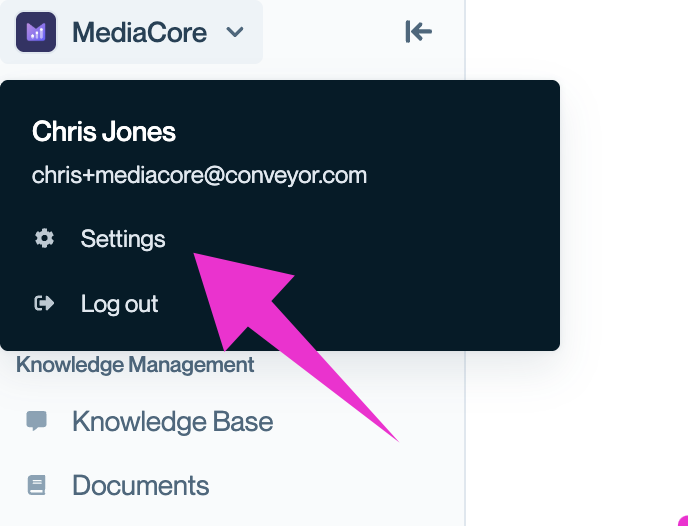
"Settings" appears under your company logo in the Navigation
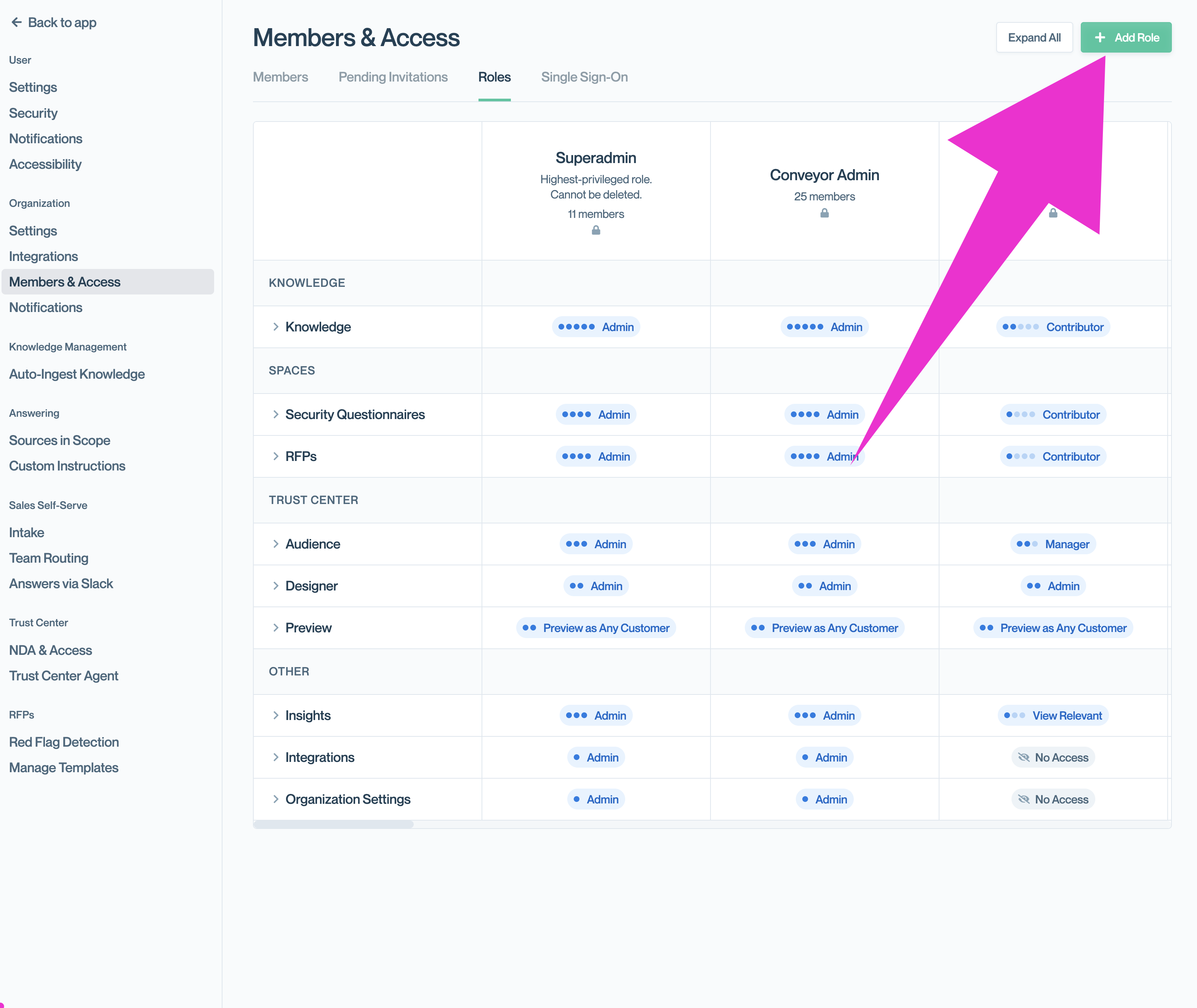
Adding a Custom Role
The "Add New Role" step allows you to create a Custom Role of your choosing. Roles require a name, and you can optionally add a Description as a reminder to all Superadmins the purpose of the Role.
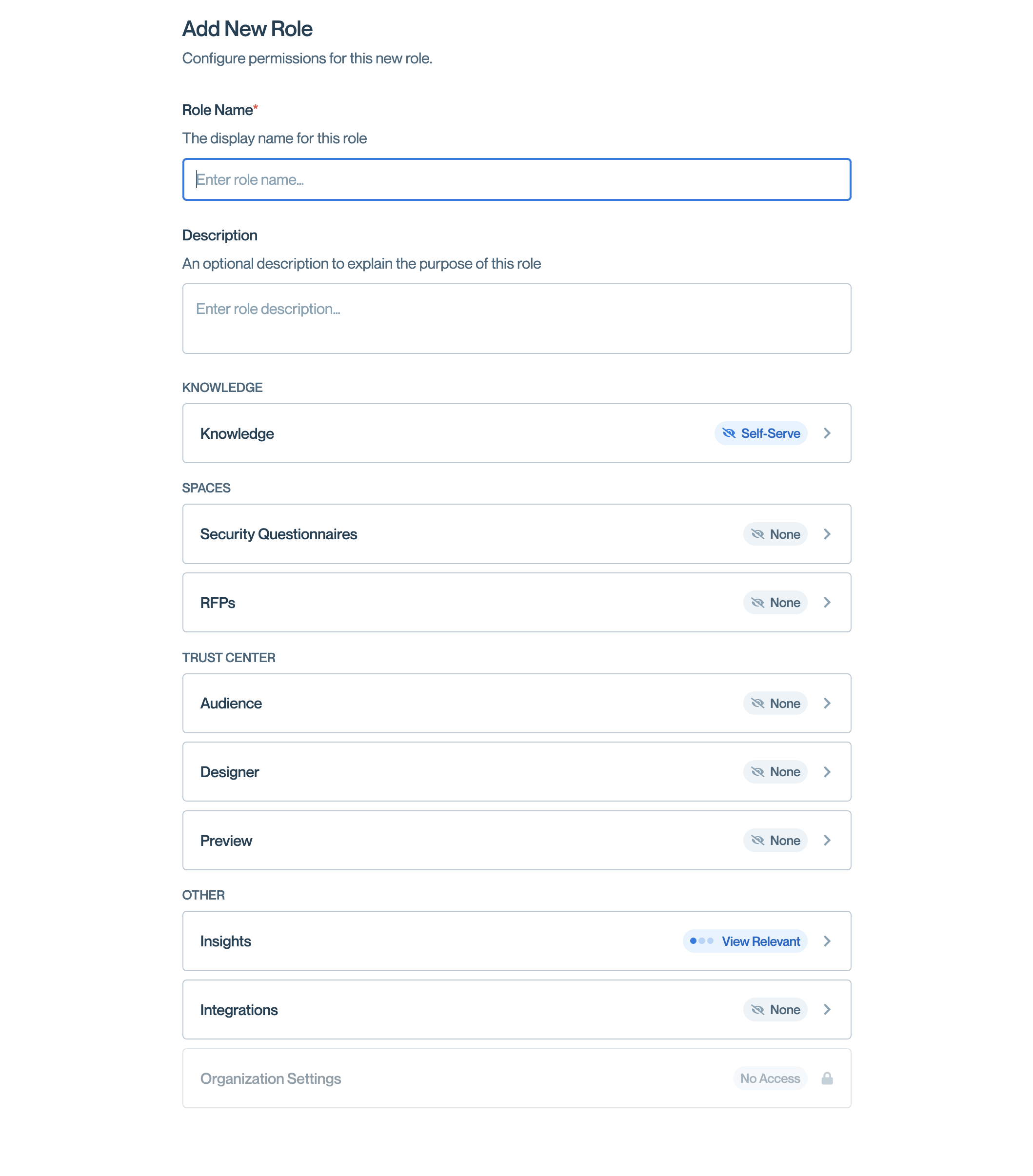
The "Add New Role" step
Conveyor's permissions are scoped to modules. Within each module are permission levels, ranging from low to high. Higher levels inherit the permissions of lower levels.
The modules are:
- Knowledge: Knowledge pertains to Documents, Curated Question and Answer pairs, Past Answers, and External Sources. The lowest level ("Self-Serve") hides the Knowledge Library from users in the role, preventing them from browsing. (Users are still able to ask one-off questions and search... just not browse.). Higher levels enable browsing, then editing where assigned, then creating, then editing all, and lastly managing settings.
- Security Questionnaires and RFPs: Each module offers the same permission levels. The lowest level hides the respective section from users in the role. Higher levels enable contributing where assigned, then creating, then contributing to all, and lastly managing settings.
- Trust Center Audience: This module pertains to your Connections (Trust Center Visitors). The lowest level hides the Audience tab from users in the role. Higher levels enable browsing the Audience tab, then managing connections (i.e., approving / rejecting customer access requests), and lastly managing settings.
- Trust Center Designer: This module pertains to the look and feel and content of the Trust Center. The lowest level hides the Designer from the users in the role. Higher levels enable managing the look and feel and content, then going live (or offline) in any given language.
- Trust Center Preview: This concept refers to users' ability to "Preview" the trust center. The lowest level hides the "Preview" from users in the role. Higher levels enable users to "Preview" as generic approved customers, then to "Preview" as customers with privileged access groups.
- Insights: This module refers to the charts and dashboards on the "Insights" tab of Conveyor. The lowest level ("View Relevant") limits users in the role only to those charts and dashboards that are granted by their permissions in the corresponding modules. (For example, a role with the "Knowledge:Admin" permission level would be able to see Knowledge-related insights on their Insights page.). Higher levels enable seeing ALL insights (excluding credit/billing) regardless of module permissions, and lastly, the ability to see credit/billing charts and export data.
Organization Settings refers to fundamental settings like Product Lines, as well as User Management. These are reserved for Superadmins.
Inviting team members
Single Sign OnConveyor supports User Management via SSO and SCIM provisioning. See: Single sign on (SSO) .
To invite team members to Conveyor directly via the app, navigate to the "Members" page, and click "Invite Member." Enter their email address to issue an invitation.
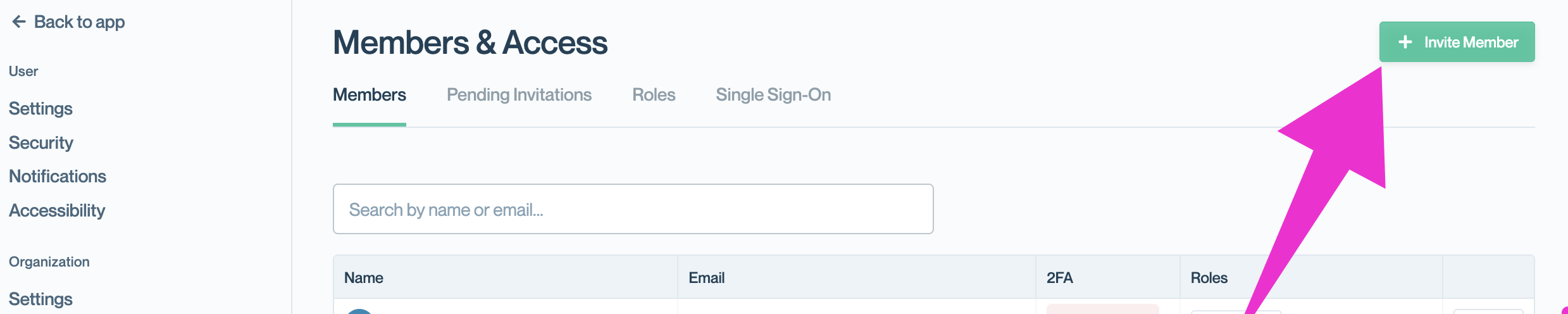
Inviting new Members
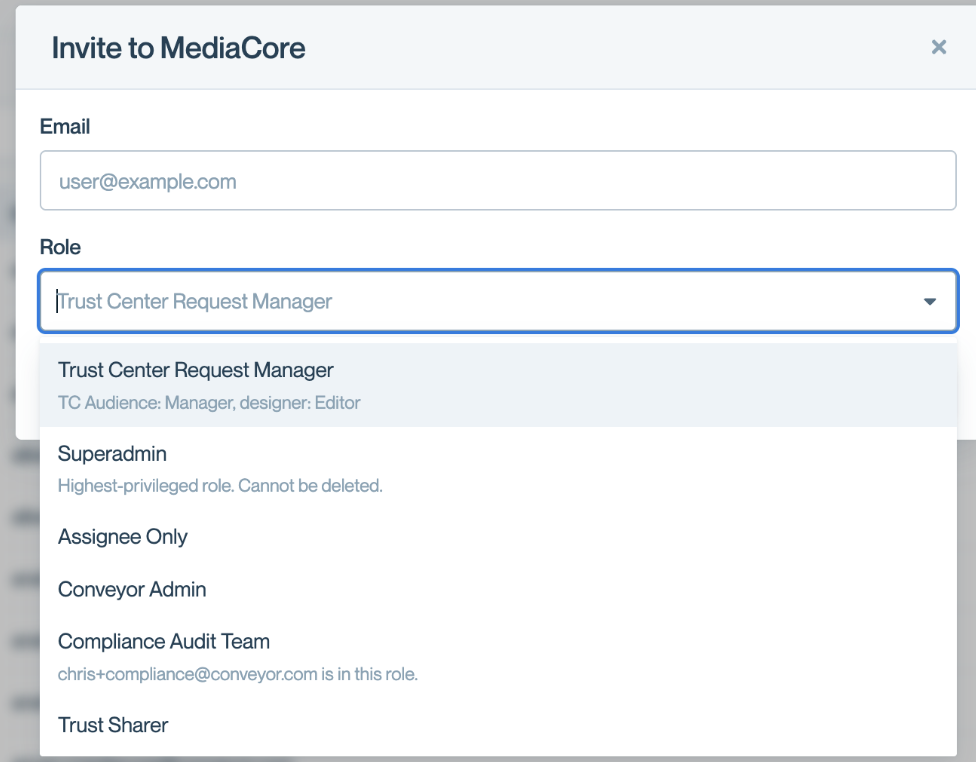
All roles (including Custom Roles) will appear here.
Managing role membership
Users can belong to multiple roles, and permissions are additiveUsers can belong to multiple roles, and permissions are additive. That means a user in more than one role will effectively have the permissions defined by the superset of the roles that user is in.
To see who is in a role and add or remove users, click on the role, and then click on the role members.
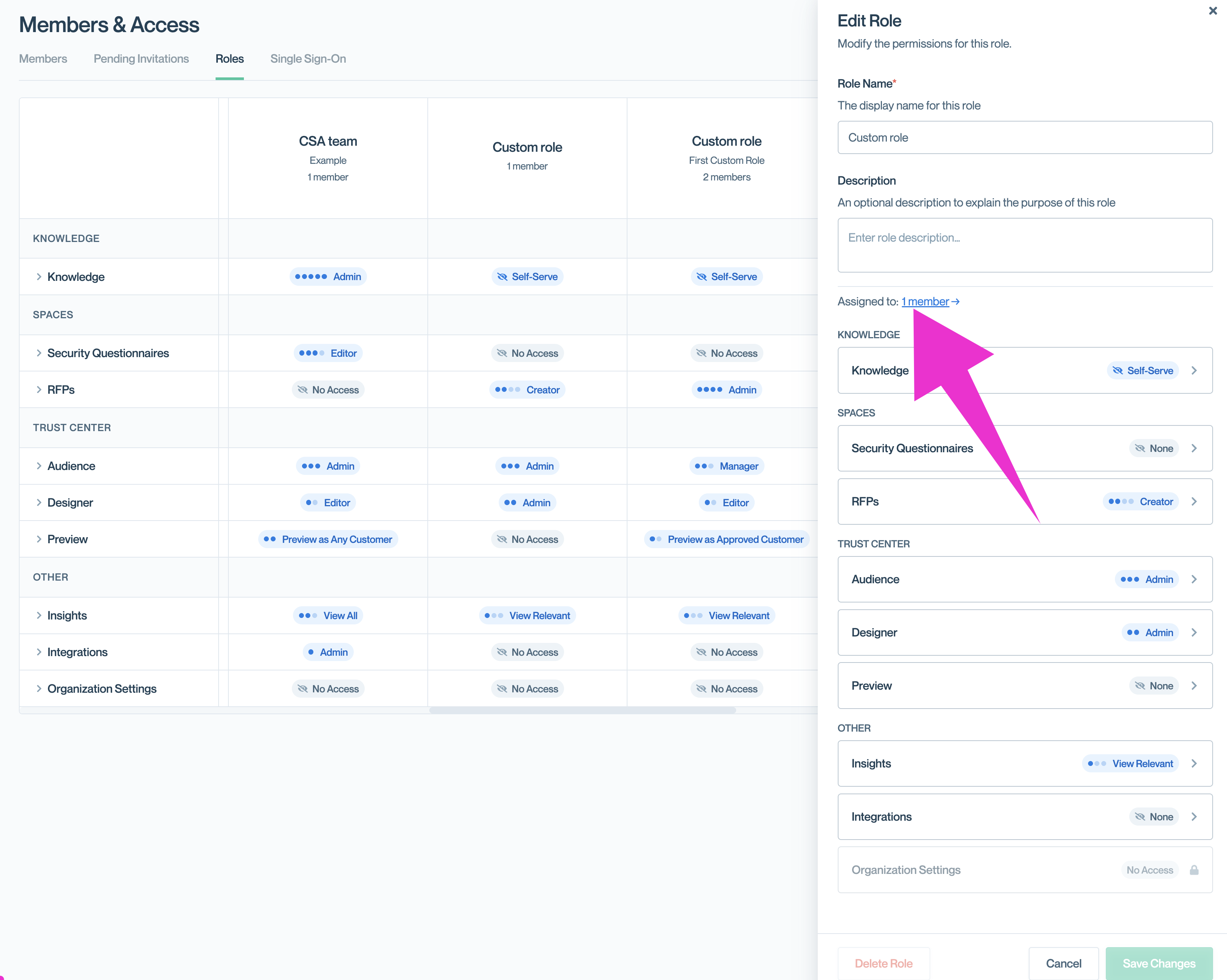
Viewing a Roles's Members
You can then quickly add one or more users to that role using the "Add Existing User" (or "Invite by Email") buttons:
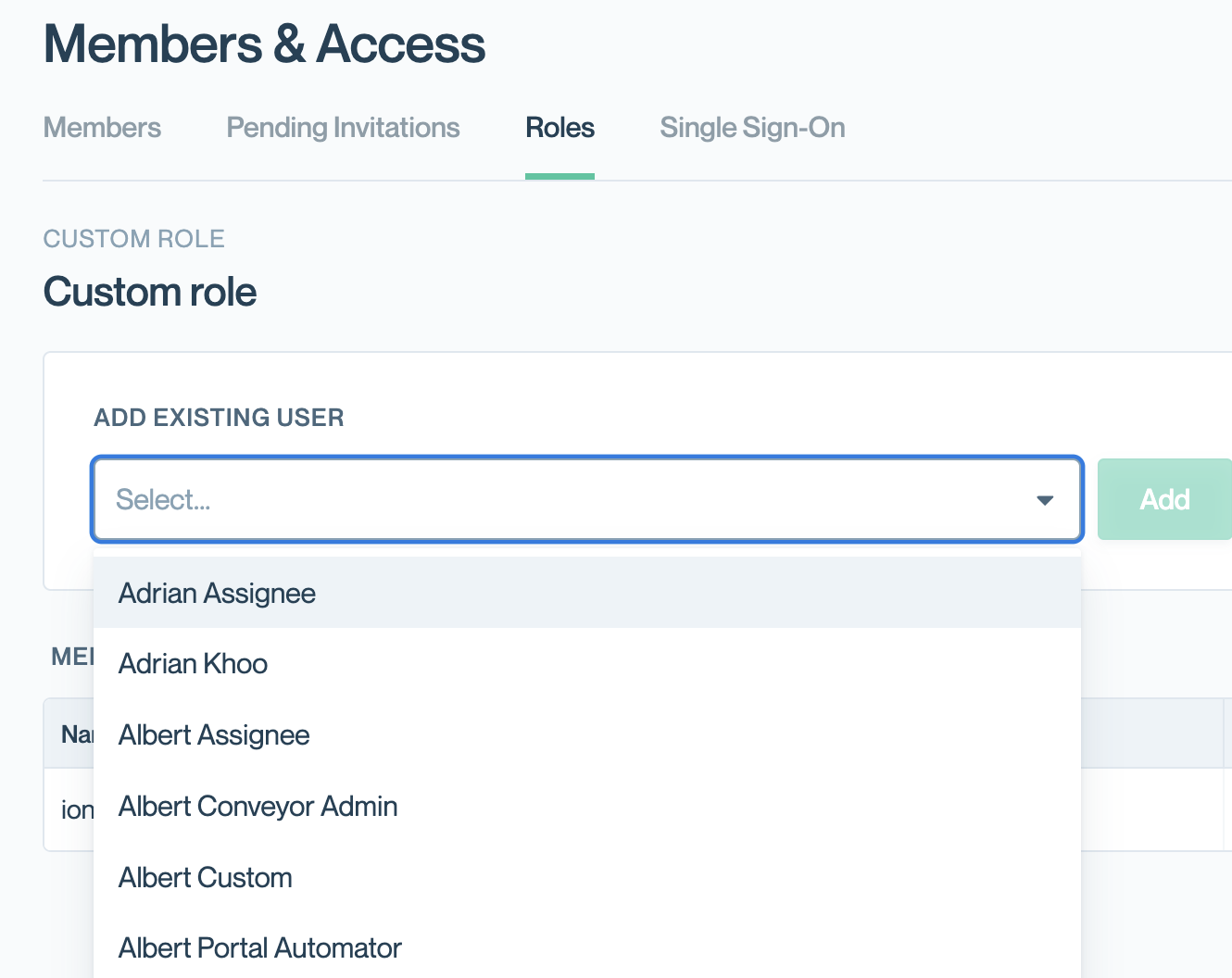
Adding users to a role
To remove users from a role (or to manage one user's role memberships) click on "Edit" next to a user, then select or deselect the roles that the user is in. Users must be in at least one role; you will not be able to deselect to zero role memberships.
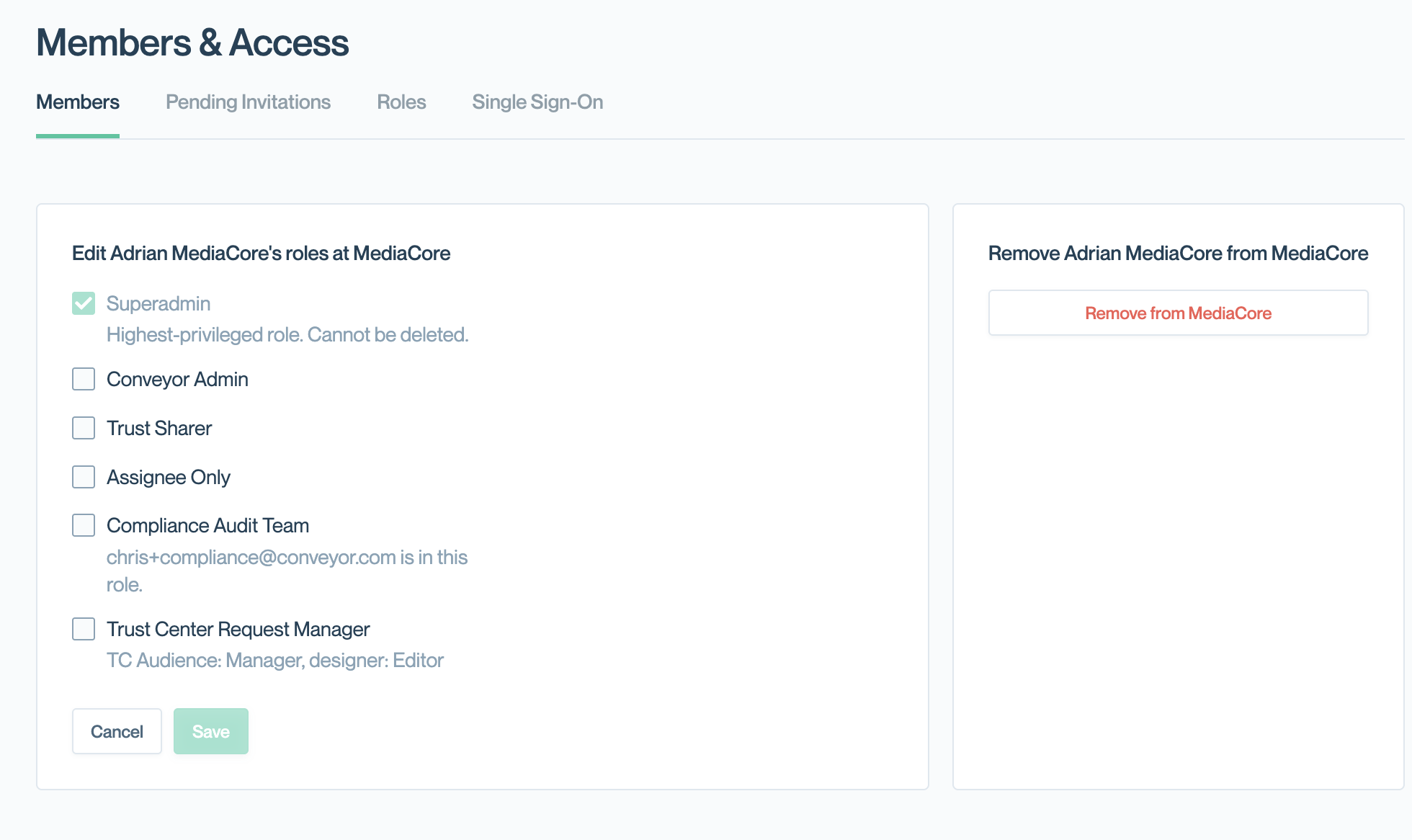
Editing a user's Role Memberships.
Updated about 2 months ago